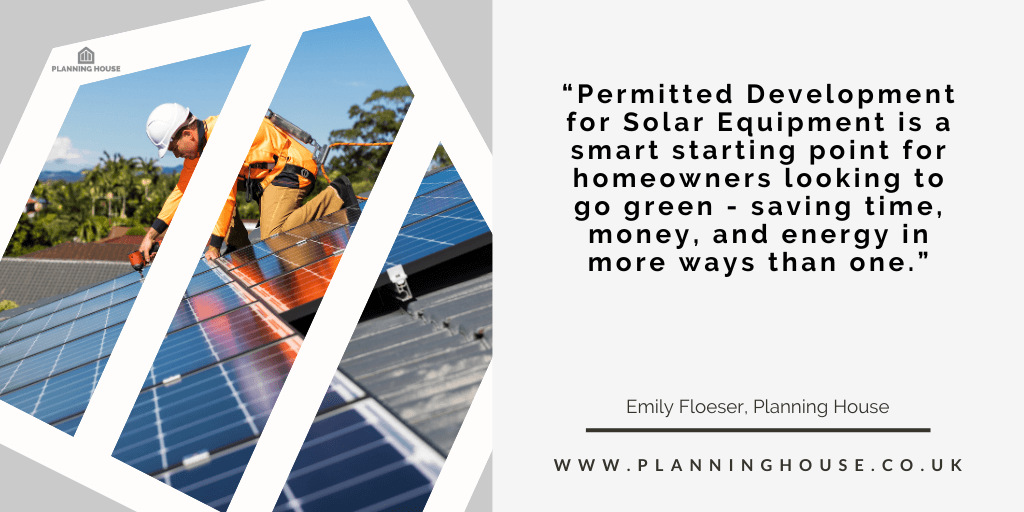
When it comes to making your property more energy-efficient, understanding Permitted Development for Solar Equipment is key. Under Class A of Part 14 of the General Permitted Development Order (GPDO) 2015 (as amended), many homeowners can install, alter, or replace solar photovoltaic (PV) or solar thermal equipment without submitting a formal planning application. But while these rights offer a welcome shortcut, they still come with specific criteria and restrictions – particularly for properties in conservation areas or those with listed status. In this article, we explain what’s covered under Class A, where limitations apply, and how to ensure your solar installation remains compliant.
Introduction to Class A Permitted Development
Permitted Development Rights (PDR) for domestic properties allow homeowners to install solar equipment without the need for full planning permission. Part 14, Class A of the General Permitted Development Order (2015) (as amended) – the GPDO – specifically addresses the installation, alteration, or replacement of microgeneration solar photovoltaic (PV) or solar thermal equipment on domestic premises. Understanding these regulations is essential to avoid legal issues and ensure your property improvements are compliant.
Permitted Development Criteria for Domestic Solar Installations
What is Allowed Under Class A?
Class A permits the following activities:
- Installation, Alteration, or Replacement: Homeowners can install, alter, or replace microgeneration solar PV or solar thermal equipment.
- Applicable Buildings: These installations are allowed on a dwellinghouse, a block of flats, or any building situated within the curtilage of a dwellinnghouse.
Development Restrictions
Despite the broad permissions, there are specific conditions under which development is not permitted:
- Protrusion Limit: The solar equipment must not protrude more than 0.2 meters beyond the plane of the wall or roof slope.
- Height Restriction: The highest part of the solar equipment must not exceed the highest part of the roof, excluding chimneys.
- Conservation and Heritage Areas: In Conservation Areas or World Heritage Sites, solar equipment cannot be installed on walls fronting a highway.
- Scheduled Monuments: Solar equipment cannot be installed on sites designated as scheduled monuments.
- Listed Buildings: Solar equipment is not permitted on buildings within the curtilage of a dwellinghouse or block of flats if the building is listed.
Conditions for Permitted Development
To ensure that solar installations do not negatively impact the aesthetics and utility of the property and surrounding area, Class A includes the following conditions:
- Minimising Visual Impact: The solar equipment should be sited to minimise its effect on the external appearance of the building as much as practicable.
- Preserving Local Amenity: The installation should be positioned to minimise its impact on the amenity of the area.
- Removal When Redundant: The solar equipment should be removed as soon as reasonably practicable when it is no longer needed.
- In the case of solar equipment installed on a flat roof located in a conservation area, area of outstanding natural beauty, National Park, the Broads or a World Heritage Site, before beginning development you must apply to your local Council for a determination as to whether the prior approval of the local planning authority will be required with respect to the impact of the appearance of the equipment. The key here is PRIOR, take a look at our article on prior approval:
In Summary
Understanding and adhering to the conditions and restrictions of Class A under Permitted Development Rights is essential for homeowners looking to install solar equipment. By following these guidelines, homeowners can benefit from renewable energy installations while ensuring compliance with legal standards and preserving the aesthetic and historical value of their properties.
Part 14 of the GPDO also sets out criteria for permitted development rights for renewable energy for your home in the following sections:
- stand-alone solar equipment on domestic premises (Class B);
- ground source heat pumps on domestic premises (Class C);
- water source heat pumps on domestic premises (Class D);
- flue for biomass heating system on domestic premises (Class E);
- flue, forming part of a microgeneration combined heat and power system, on a dwellinghouse or a block of flats (Class F);
- air source heat pumps on domestic premises (Class G);
- wind turbine on domestic premises (Class H);
- stand-alone wind turbine on domestic premises (Class I);
Part 14 then goes onto PDR’s for non-domestic premises and renewable energy. Being aware of what you can do under permitted development can be beneficial as it can be expensive to install or replace renewable energy equipment, however it can also be expensive having to go through the planning process which you may not have factored in.
Related Content
We’ve created a collection of articles on Energy, to help unravel the red tape of town planning! If you need support with your Energy project or any other town planning issue feel free to Contact Us.
If you’re not sure if you need help from a Town Planner take a look at blog on When to Hire a Town Planner our download a Guide on How to Choose a Town Planner.